

Control panel wire colour codes: NFPA 79 vs IEC 60204-1
Which colour each conductor gets under NFPA 79 (2024) and IEC 60204-1, clause by clause, what is mandatory, and a legend for a panel built for both.
By the LADX engineering team
Short answer
Under NFPA 79 (2024), power wiring is black, AC control red, DC control blue, and anything still live with the main disconnect off is orange, with a blue stripe for DC. The equipment grounding conductor is green, with or without yellow stripes. IEC 60204-1 requires green-and-yellow for protective earth and blue for neutral, and recommends black, red, blue and orange for the rest.
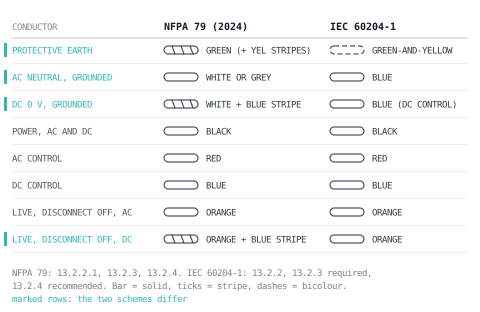
Wire colour is the first thing anyone reads when they open a panel, and the thing they rely on to tell them what might still be live. Two schemes cover most machinery: NFPA 79 in North America and IEC 60204-1 almost everywhere else. They agree on more than people expect, and they part company in exactly the places that matter: earth, neutral, the grounded side of a DC supply, and circuits that stay live with the isolator off.
The editions this is based on
Colour rules change between editions, so here is exactly what this article relies on.
- NFPA 79, 2024 edition, which was current at the time of writing (October 2026). The next edition, due as 2027, is in NFPA's Fall 2026 revision cycle. NFPA 79 is read-only online and paid in print, so the clause wording here was checked against the text NFPA publishes in its own committee reports for the 2024 edition: the First Draft report, the Second Draft report and the public input responses, plus the public inputs for the 2027 cycle, which quote the 2024 text.
- IEC 60204-1:2016 with Amendment 1:2021, edition 6.1, the consolidated current version with a stability date of 2027. Clause 13.2 is Identification of conductors, with 13.2.2 for the protective conductor, 13.2.3 for the neutral and 13.2.4 for identification by colour. The foreword's list of national differences confirms the base rules for 13.2.2 and 13.2.3. The wording quoted for 13.2.4 is the 2005 edition's, as published identically in Japan as JIS B 9960-1:2008, because the 2016 text of that subclause was not available to check. The clause and its heading carry on in the 2016 edition; confirm the wording in your copy.
- IEC 60445:2021, edition 7, the general standard for conductor identification that absorbed IEC 60446. Its 2021 revision made the colours for certain designated conductors requirements rather than recommendations.
The two schemes side by side
| Conductor | NFPA 79 (2024) | Clause | IEC 60204-1 | Clause |
|---|---|---|---|---|
| Protective earth (equipment grounding conductor) | Green, with or without one or more yellow stripes, green predominant; reserved for this use | 13.2.2.1 | Green-and-yellow bicolour; reserved for the protective conductor | 13.2.2 |
| AC grounded conductor or neutral | White, grey, or three continuous white stripes on insulation other than green, blue or orange | 13.2.3.1 | Blue, where the neutral is identified by colour alone | 13.2.3 |
| DC grounded conductor (an earthed 0 V) | White with a blue stripe | 13.2.3.2 | No separate colour; blue is recommended for DC control circuits | 13.2.4 |
| Ungrounded AC and DC power | Black | 13.2.4.3 | Black (recommended) | 13.2.4 |
| Ungrounded AC control | Red | 13.2.4.3 | Red (recommended) | 13.2.4 |
| Ungrounded DC control | Blue | 13.2.4.3 | Blue (recommended) | 13.2.4 |
| Ungrounded AC, live with the main disconnect off | Orange, reserved for this use | 13.2.4.1 | Orange, for excepted circuits (recommended) | 13.2.4 and 5.3.5 |
| Ungrounded DC, live with the main disconnect off | Orange with a blue stripe, reserved for this use | 13.2.4.1 | Orange (recommended) | 13.2.4 and 5.3.5 |
| Grounded conductor, live with the main disconnect off | White with an orange stripe, AC or DC | 13.2.3.2 | No separate colour |
IEC 60204-1 also lists the colours that may be used at all: black, brown, red, orange, yellow, green, blue (including light blue), violet, grey, white, pink and turquoise, a list taken from IEC 60757. Green or yellow should not be used where they could be confused with the green-and-yellow of the protective conductor.
What is mandatory, and what is advice
The two standards use different verbs, and the verbs matter more than the colours.
NFPA 79 is mostly mandatory. The equipment grounding conductor shall be green, with or without yellow stripes, and that colour is reserved for it (13.2.2.1). An AC grounded conductor shall be white, grey or white-striped (13.2.3.1). Orange, and orange with a blue stripe, shall identify ungrounded conductors that stay live with the disconnect off, and each is reserved for that use only (13.2.4.1, as revised for 2024). The black, red and blue list in 13.2.4.3 is worded as colours that shall be permitted where colour coding is used, and the committee has pointed to 13.2.4.4 as the route to other colours. There is also a posted alternative: where the mandatory colours are too restrictive, Exception No. 2 to 13.2.3.2 allows other identification, such as marking tape or tagging, provided it is permanently posted inside the main control enclosure.
IEC 60204-1 is mandatory at two points only. The protective conductor shall be green-and-yellow when it is identified by colour, and that bicolour shall not be used for anything else; in the 2005 wording, one colour covers 30 to 70 percent of the surface over any 15 mm length. A neutral identified by colour shall be blue; the 2005 wording also recommended the light shade, to avoid confusion. Everything in 13.2.4 is a recommendation, introduced with should.
The IEC standard's own foreword records the North American position: in the USA and Canada, green (with or without yellow stripes) is used as the equivalent of green-and-yellow, and white or grey is used for an earthed neutral instead of blue.
Orange: the colour that protects the electrician
An excepted circuit is one that is not switched off by the machine's main disconnect: an interlock fed from a neighbouring machine, a supply kept alive for a controller, maintenance lighting. Cable maker Lapp, describing its orange control cable, lists maintenance lighting and socket circuits, undervoltage protection circuits and interlocking control circuits as typical examples.
Somebody who isolates the panel and starts work expects everything inside to be dead. Orange is the warning that some of it is not. NFPA 79 2024 adds a requirement on top of the colour (5.1.13.4): where excepted circuits are not disconnected by the main disconnect, a permanent safety sign goes next to the disconnect handle, the documentation says so, and inside the enclosure either each excepted circuit has a permanent sign near it or its conductors are identified by colour per 13.2.4.
Orange is not a general colour for anything special. Use it for a fused supply that dies with the isolator and you have trained everybody who opens that panel to ignore it.
The DC common is where the schemes part
Most PLC panels run 24 V DC control, so this is where the difference bites. Under NFPA 79, +24 V is blue as an ungrounded DC control conductor, and if the 0 V is grounded it is a grounded conductor and goes white with a blue stripe (13.2.3.2). If the 0 V is not grounded, it is ungrounded and the blue of 13.2.4.3 applies.
IEC 60204-1 recommends blue for DC control circuits and does not separate the two sides of the supply by colour. If your drawings need +24 V and 0 V to look different, and for fault-finding they should, choose the distinction, put it on the legend, and use it everywhere. The input and output side of the same question, which terminal is common and which is switched, is covered in sinking and sourcing and I/O wiring.
Worked example: one 24 V DC panel for both markets
A machine builder ships the same panel to Europe and the US: three-phase supply, a 24 V DC power supply with its 0 V earthed, PLC I/O at 24 V DC, and a safety interlock fed from the customer's conveyor, live whenever the conveyor is. No neutral is used inside the panel. Can one set of colours satisfy both standards?
| Function | Colour chosen | NFPA 79 (2024) | IEC 60204-1 |
|---|---|---|---|
| Protective earth | Green-and-yellow with green covering more than half the surface | Green predominant with yellow stripes: complies (13.2.2.1) | Bicolour within 30 to 70 percent: complies (13.2.2) |
| Three-phase power | Black | Complies (13.2.4.3) | Recommended colour (13.2.4) |
| +24 V DC control | Blue | Complies (13.2.4.3) | Recommended colour (13.2.4) |
| 0 V DC, earthed | White with a blue stripe | Required for a grounded DC conductor (13.2.3.2) | A combination of permitted colours, no confusion with earth: acceptable |
| Interlock from the conveyor, 24 V DC | Orange with a blue stripe | Required (13.2.4.1) | Orange is the recommendation; the blue stripe is a permitted combination |
It works, because IEC 60204-1 permits combinations of its listed colours where nothing can be confused with the protective conductor, and NFPA 79's requirements are stricter. Add a neutral and it stops working: IEC wants blue, NFPA 79 wants white or grey and specifically excludes white stripes on blue. NFPA's committee rejected a 2021 public input that would have allowed blue for the grounded conductor on machines built for both markets, citing confusion with the National Electrical Code's white or grey. Panels with a neutral need a build for each market, or the neutral kept out of the panel.
Put the scheme on the legend sheet so nobody has to deduce it:
CONDUCTOR COLOURS (NFPA 79:2024 and IEC 60204-1:2016+A1:2021)
GREEN-YELLOW  protective earth (green predominant)
BLACK         power circuits, AC and DC
BLUE          +24 V DC control
WHITE/BLUE    0 V DC, earthed at the PSU
ORANGE/BLUE   24 V DC, external source: LIVE WITH Q1 OFF
In LADX CAD the legend template is the place for this block, beside the title block. The cable schedule template, written against IEC 60204-1 for wiring practice, has Function and Voltage columns; add a core colour column, or record the scheme in Notes, so the installer works from the same legend as the panel builder.
Where local practice differs
- Mains colours are a different standard. Phase colours on a building installation follow IEC 60445 and national wiring rules: brown, black and grey for L1, L2 and L3, blue for neutral, green-and-yellow for earth. That is not the same as the IEC 60204-1 recommendation of black for all power wiring inside a machine, and both appear in the same plant.
- North America. The USA and Canada keep green earth and white or grey neutrals, as the IEC foreword itself records.
- Customer specifications. Many end users publish their own wiring specification. Where one exists it normally takes precedence over a recommendation, never over a mandatory clause, and it should be quoted on the legend sheet.
- Older machines. A panel built to an earlier edition, or to a builder's own scheme, may use colours this table does not. Read the legend and the drawings, never the colour alone.
What goes wrong
- Two schemes in one panel. A European panel modified in the US, or the reverse, ends up with two meanings of blue. Whoever modifies it adopts the existing legend or rewires the circuit.
- Orange for anything unusual. It means live with the isolator off, nothing else.
- Plain green or yellow for signals. IEC 60204-1 advises against either where it could be confused with the protective conductor, and NFPA 79 reserves green for grounding.
- Assuming blue is 0 V. Under both schemes blue is the DC control colour, and the +24 V is blue too.
- Earth taken for granted. Colour identifies the protective conductor; it does not prove it is connected. That is a continuity test, covered with the rest of earthing and bonding.
- Multicore cables. Cores in a multicore are often numbered rather than coloured. NFPA 79 permits multiconductor cables to be permanently reidentified at installation (Exception No. 1 to 13.2.3.2); do it with sleeves at both ends, and say so on the panel drawings.
Sources and further reading
- NFPA 79 Electrical Standard for Industrial Machinery: editions and development (NFPA)nfpa.org
- NFPA 79 First Draft report for the 2024 edition, incl. 13.2.3.2 and 13.2.4.1 (NFPA, PDF)docinfofiles.nfpa.org
- IEC 60204-1:2016+AMD1:2021 CSV, edition 6.1 (IEC webstore)webstore.iec.ch
- IEC 60445:2021, identification of conductors and terminals (IEC webstore)webstore.iec.ch
- IEC 60446 wiring colours and the merge into IEC 60445 (Wikipedia)en.wikipedia.org
Common questions
- What colour wire is used for 24 V DC in a control panel?
- Blue, under both schemes, for ungrounded DC control conductors: NFPA 79 lists blue for them in 13.2.4.3, and IEC 60204-1 recommends blue for DC control circuits in 13.2.4. Where the 0 V is grounded, NFPA 79 makes it white with a blue stripe. IEC 60204-1 assigns the 0 V no separate colour.
- What does an orange wire mean in a control panel?
- That the conductor can still be live with the main disconnect switched off, because it is fed from outside the panel, such as an interlock from another machine or a separate supply. NFPA 79 2024 reserves orange for this alone, with a blue stripe for DC. IEC 60204-1 recommends orange for these excepted circuits.
- Is NFPA 79 mandatory?
- NFPA 79 is a standard, not a law. It becomes binding when something adopts it: a contract, a customer specification or an authority having jurisdiction. Check which edition that document names, because the colour rules changed in detail for 2024, when orange with a blue stripe was added for DC conductors that stay live with the disconnect off.
- Can I use green-and-yellow earth wire on a panel for the US?
- Yes, with a condition. NFPA 79 2024 permits green with one or more yellow stripes for the equipment grounding conductor, provided green is the predominant colour. IEC bicolour wire can be up to 70 percent yellow, so check the cable: green covering more than half the surface satisfies both standards.
- Which edition of NFPA 79 is current?
- The 2024 edition at the time of writing (October 2026). NFPA's development page shows the next edition, due as 2027, in its Fall 2026 revision cycle. Its first draft includes a change to 13.2.2.1 that would allow green-and-yellow bicolour in a 30 to 70 percent ratio, matching IEC practice. Check the final text when it is issued.
Keep reading
- Compliance
Factory acceptance test checklist for a PLC control panel
A FAT checklist you can copy for a PLC panel: documents, inspection, power-up, I/O point by point, interlocks, alarms, HMI, safety, failure modes, sign-off.
- Safety
Stop categories 0, 1 and 2, and why an E-stop is not a guard
Three stop categories, what each removes, and the reason a normally closed E-stop reads true when everything is healthy.
- Panel & Electrical
Free control panel design software: electrical CAD compared
QElectroTech, ProfiCAD Home, the SEE Electrical trial and LADX CAD compared on licence, page limits, cross references, BOMs and DXF, from each vendor's pages.