

The five IEC 61131-3 languages, and when each is right
One standard, five notations. Most projects use two, and choosing badly makes a program nobody wants to maintain.
By the LADX engineering team
Short answer
IEC 61131-3 defines Ladder Diagram, Function Block Diagram, Sequential Function Chart, Structured Text and Instruction List. Ladder dominates discrete machine control because maintenance staff read it; Structured Text suits calculation and data handling; SFC suits sequences with clear steps; FBD suits process and signal flow; Instruction List is deprecated and should not be used for new work.
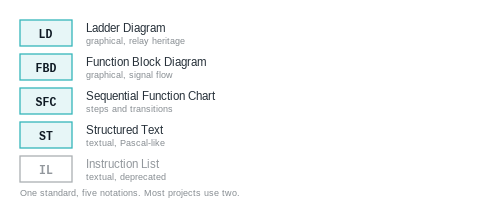
One standard, five notations, and a lot of arguments about which to use.
Ladder Diagram
Graphical, descended from relay schematics. It dominates discrete machine control for one reason that has nothing to do with expressiveness: a maintenance technician can read it at three in the morning without being a programmer.
That is a genuine engineering property and it is why ladder outlives every prediction of its death.
Structured Text
Textual, Pascal-like. Far better than ladder at calculation, string handling, arrays and loops. Most platforms let you call an ST routine from a ladder rung, which is usually the right structure: ladder for the machine logic, ST for the maths.
Sequential Function Chart
Steps and transitions. Genuinely good for anything with a clear sequence: batch, start-up, complicated machine cycles. It makes 'which step are we on' a first-class question rather than something you infer from a set of bits.
Function Block Diagram
Graphical, signal flow. Common in process industries and in anything descended from a control-loop drawing.
Instruction List
Deprecated. You will meet it as Siemens STL in older programs. Do not start new work in it.
The practical rule: ladder for what maintenance must read, Structured Text for what maths must be right, SFC for what has steps. Mixing deliberately beats picking one and forcing everything into it.
Sources and further reading
- IEC 61131-3 programming languages (Wikipedia)en.wikipedia.org
- PLCopen: IEC 61131-3 logicplcopen.org
Common questions
- Which IEC 61131-3 language should I learn first?
- Ladder, because it is what you will meet most and what maintenance staff can read. Learn Structured Text second: it handles calculation, string work and data manipulation far better than ladder, and most platforms let you call an ST routine from a ladder rung.
- Is Instruction List still used?
- It is deprecated in the third edition of the standard and should not be used for new work. You will still meet it in older Siemens programs as STL, where it survives because it can express things the graphical languages cannot, but there is no reason to start a new project in it.
Keep reading
- Languages
Structured Text for people who think in ladder
The translation is mostly mechanical, and four constructs cover the majority of real code.
- Languages
Structured Text examples: 12 complete IEC 61131-3 programs you can run
Twelve complete Structured Text programs from a seal-in to a two-task program, each with its purpose, what to watch when it runs and the classic mistake.
- Languages
What does IEC 61131-3 compliant mean? Editions, statements and PLCopen
What an IEC 61131-3 compliance statement is, how the editions and PLCopen levels differ, why two compliant products still behave differently, and how to read a vendor's table.