

What does IEC 61131-3 compliant mean? Editions, statements and PLCopen
What an IEC 61131-3 compliance statement is, how the editions and PLCopen levels differ, why two compliant products still behave differently, and how to read a vendor's table.
By the LADX engineering team
Short answer
IEC 61131-3 compliant means the vendor claims its programming system implements the parts of the standard listed in its own compliance statement: feature tables saying what is supported, plus the values it chose where the standard leaves a choice. The standard itself does not certify anyone. Independent certification exists through PLCopen, and it covers a stated subset, so two compliant products can still differ.
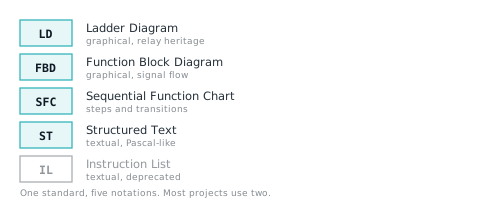
"IEC 61131-3 compliant" is a claim, not a certificate, unless a certificate is named. This article explains what the claim should contain, how to check it, and why two products that both make it can still run the same program differently. We read the public parts of the standard (contents, foreword, change lists) and PLCopen's certification pages; the clause text itself is sold, so we describe its structure and not its wording.
The short answer
A compliant product has a compliance statement: a document, or a report the tool produces, that says which language features it implements and states the choices the standard leaves to it. The third edition's contents list this as clause 5, Compliance, with Feature tables (5.2) and Implementer's compliance statement (5.3), and shows an example statement as a figure. Beyond that statement, independent certification is optional and comes from PLCopen, not IEC.
The IEC foreword to the 2013 edition says IEC provides no attestation of conformity itself and that independent certification bodies do. So "compliant" with no named tester means the vendor says so. That is not worthless: a detailed statement is checkable, and a vendor that publishes one is easier to hold to it. But read it as a claim.
The editions
Three editions matter today. What follows is what IEC and national-body pages let us verify.
| Edition | Year | What we can verify |
|---|---|---|
| Second | 2003 | Replaced by the third edition. The 2013 foreword names it as the edition it cancels. |
| Third | 2013 | A compatible extension of the second. The main extensions are new data types and conversion functions, references, namespaces, and the object-oriented features of classes and function blocks. Published February 2013; now marked superseded. |
| Fourth | 2025 | Published in May 2025 and adopted in Europe as EN IEC 61131-3:2025 in July 2025. NEK's listing names UTF-8 strings with their functions as a significant technical change, and an Annex B listing features added, removed or deprecated against 2013. |
That is all we state about edition 4, because the clause text is not public. Annex B of the standard is where to check whether a feature is in or out, and a vendor claiming edition 4 should point at it. Instruction List is deprecated from the third edition, which is why many statements mark it "not implemented".
What a compliance statement contains
Read a statement as three parts. The names below are ours, the structure follows the contents of the third edition.
- Feature tables. One row per feature in the standard, usually numbered to match the standard's tables, with the vendor's answer: supported, not supported, supported with a difference.
- Implementation-dependent parameters. The values the standard leaves open. Examples: the longest identifier, the default and maximum string length, the range of the time type, what integer overflow does, what a division by zero does, how a real is rounded to an integer, how tasks are scheduled, what a warm restart keeps. A statement that lists no values leaves you to find them by experiment.
- Implementer's notes. Everything that does not fit a yes or no: extensions, limits, a different spelling, a feature that works only in one language.
The statement may be in the manual or generated by the programming system. What matters is that two engineers would agree on what it says.
PLCopen: the certification that exists
PLCopen is the independent body that certifies IEC 61131-3 programming systems. From its certification pages: testing is done by an audited independent laboratory (it lists ifak in Germany and the Shenyang Institute of Automation in China), the lab and applicant arrange it privately, and PLCopen issues the certification when it receives a passing report. Certification is open to PLCopen members, lasts three years and covers later versions the vendor declares compliant.
There are three levels.
- Base Level. The lowest, covering a core kernel for each language. PLCopen notes that for Structured Text it is superseded by the two higher levels.
- Conformity Level. The supplier chooses which of the 26 IEC data types the product supports, and only those are tested. PLCopen says plainly that, because the test is pass or fail, two certified products can differ in the data types they support, which can affect reuse of function blocks.
- Reusability Level. Tests exchanging functions and function blocks as plain-text Structured Text files, each with one FUNCTION_BLOCK or TYPE section. Reuse is guaranteed only for matching supported data types and standard functionality, and supplier-specific elements may have no equivalent on the receiving system.
PLCopen also lists eight checks for recognising an IEC 61131-3 programming system, from standard and derived data types to programs, functions and function blocks, local data, defined interfaces, symbolic code independent of addresses, standard languages and library, and certification by an independent tester. Only the last needs a third party. The others you can check yourself in an afternoon.
Why two compliant products still differ
Because compliance is a subset plus choices. The usual sources of difference are these.
- Vendor extensions. Pragmas, extra types, extra statements, special-purpose blocks. Allowed, and the main reason code does not move.
- Object-oriented features. Classes, methods, interfaces and properties came in with the third edition. Many compliant systems do not implement them, and many ladder-first systems never will.
- Data type widths and the types supported. Under PLCopen's conformity level the supplier picks the types. A system without LINT or LREAL cannot take a program that uses them.
- Strings. Default and maximum length, single-byte or wide characters, and in the fourth edition UTF-8 handling.
- Timers. Where a timer ticks from: the scan, a task interval, a hardware clock. A timer's resolution is a property of the system, not of
TON. - Edge cases. Overflow, rounding, division by zero, out-of-range array indexes, and whether any of them stops the controller.
- Scheduling and restarts. What runs when, whether a higher priority task can interrupt a lower one, what survives a warm restart. The standard sets a model; the implementation sets the details. The tasks and watchdog article goes through this one.
How to read a vendor's compliance table
Work through it in this order. It takes ten minutes and saves a port.
- Find the edition it cites. A 2003 statement says nothing about references, namespaces or classes.
- Check the languages row. "Supported" for ladder may mean the vendor's dialect. Look for SFC and FBD separately; they are often absent.
- Read the not implemented list before the implemented one. It is shorter and it is where your code breaks.
- Find the implementation-dependent parameters. If there are none, ask. If there are, compare each with the target you have in mind: string length, integer behaviour, time type, task rules.
- Look for a certificate: which level, which version, which lab, which date. Three years is the validity PLCopen states.
- Look for extensions and decide which of them your code already uses.
- Then test. A program that depends on a corner of the standard is a test case, and it should run on both systems before you trust either statement. Ideas for how are in moving PLC code between vendors.
A worked example: LADV's own statement
The Wartens LADV virtual PLCs publish a statement at LADV-CS, and it is a fair example because it says what is missing. It opens with a sentence that matters more than any table: it is a statement by Wartens of what LADV implements, not a certification by PLCopen or any test body. LADV is a behavioural IEC 61131-3 controller in the browser for learning and for testing logic before commissioning. It is not certified, real time or safety rated, and it does not control machinery.
The languages table reads like this.
| Language | Status in LADV |
|---|---|
| Structured Text | Implemented |
| Ladder Diagram | The LADX ladder dialect: contacts, coils, latches, one-shots, timers, counters, compares, math, JSR. Not the standard's full ladder. |
| Function Block Diagram | Not implemented |
| Sequential Function Chart | Not implemented |
| Instruction List | Not implemented; deprecated in the third edition |
Within Structured Text, the elementary types (BOOL through LWORD, REAL, LREAL, TIME, LTIME, the date types, STRING, WSTRING, CHAR, WCHAR), enumerations, subranges, arrays, structures, the variable sections, RETAIN, direct addresses, functions, function blocks and programs, all the statements, and CONFIGURATION, RESOURCE and TASK are implemented. Not implemented: classes, methods, interfaces and properties; REF_TO and dereferencing; namespaces; and actions and SFC elements in Structured Text source. So an object-oriented third-edition program will not compile on LADV, and it will say so with a line number.
Then the implementation-dependent parameters, which are the part most statements skip. A selection:
| Parameter | LADV value |
|---|---|
| Identifier length | 64 characters, case-insensitive |
| STRING | 80 characters by default, STRING[n] up to 1024 |
| Integer overflow | Wraps, two's complement, at the width of the type |
| LINT, ULINT, LWORD | Exact to 53 bits, saturating beyond |
| REAL to integer | Rounds half to even; TRUNC truncates |
| Integer division by zero | Faults the controller, code F310, outputs off |
| Real division by zero | Infinity or NaN, no fault |
| Array index out of range | Faults, code F311 |
| Timer resolution | The interval of the task that calls the timer |
| Task scheduling | Non-preemptive; due tasks run in priority order, 0 highest |
| Warm restart | RETAIN kept on retentive CPUs, the rest re-initialised |
| Watchdog | A tick longer than the CPU's watchdog time faults it, code F300 |
Several of those are corners where products differ. This program shows three; run it on LADV, then run the equivalent on your target.
PROGRAM Main
VAR
  Big : INT := 32767;
  Wrapped : INT;
  Half : INT;
  Next_Half : INT;
  Chopped : INT;
END_VAR
  Wrapped := Big + 1;
  Half := REAL_TO_INT(2.5);
  Next_Half := REAL_TO_INT(3.5);
  Chopped := DINT_TO_INT(TRUNC(2.5));
END_PROGRAM
On LADV Wrapped is -32768, Half is 2, Next_Half is 4 and Chopped is 2: wrap at 16 bits, round half to even, truncate toward zero. Another system could saturate the INT, round 2.5 up to 3, or fault. None of those would necessarily make it non-compliant, as long as it says so. That is the whole point of the parameters table.
What to do with this
If you are choosing a platform, ask for the statement and read the not-implemented list against your code. If you are moving code, test the corners above on both sides. If you are teaching or learning, use a system whose statement is honest about its limits, because behaviour you learn from a simulator that silently differs from the standard is behaviour you will unlearn on a real controller. For a map of the five languages see the IEC 61131-3 languages; for the Structured Text itself, Structured Text examples has twelve programs that compile on LADV; CODESYS explained covers the most widely licensed implementation of the standard.
How we tested
On 2026-11-01 we compiled and ran the program in this article on the LADV controller model CPU 310 and checked the four values quoted. The LADV statement was read from the same source that generates the page at /vplc/docs/iec-61131-3-compliance, so the tables above match it. Every Structured Text program on this page compiles on the LADV compiler, checked automatically in the site's test suite.
Not tested or not verified: we did not read the clause text of any edition of the standard, only the public contents, foreword and national-body listings. We did not confirm PLCopen's current list of certified products, or whether any product is certified against edition 4. PLCopen's certification fee and member-only rules are as stated on its pages and may change. We did not test any other vendor's compliance statement.
Sources and further reading
- IEC 61131-3:2013 (edition 3), IEC webstore, with the note that it is superseded by the 2025 editionwebstore.iec.ch
- EN IEC 61131-3:2025 (edition 4), NEK listing: UTF-8 strings and the Annex B change listonline.standard.no
- IEC 61131-3:2013 preview: contents, foreword and clause 5 headings (VDE Verlag)assets.vde-verlag.de
- PLCopen Logic Certification: Base, Conformity and Reusability levelsplcopen.org
- PLCopen: how to recognise an IEC 61131-3 programming systemplcopen.org
- LADV-CS: IEC 61131-3 compliance statement (Wartens)ladx.ai
Common questions
- Is there an official IEC 61131-3 certificate?
- Not from IEC. The foreword of the 2013 edition says IEC itself does not provide any attestation of conformity, and that independent bodies do. For this standard that body is PLCopen, which certifies a programming system after an audited laboratory tests it, and only for the language and data type subset the vendor declares.
- Which edition of IEC 61131-3 is current?
- Edition 4, published in 2025. The IEC webstore lists the 2013 third edition as superseded by IEC 61131-3:2025, with a withdrawal date of 22 May 2025. The European adoption, EN IEC 61131-3:2025, dates from July 2025. Many products on sale still describe themselves against the 2003 or 2013 editions, so check which one a statement cites.
- Does IEC 61131-3 compliant mean my code will run on any PLC?
- No. Compliance means a stated subset follows the standard. Code that uses vendor extensions, different data type widths, a different timer resolution or a different restart behaviour can behave differently or fail to compile elsewhere. PLCopen's reusability level addresses part of this by testing the exchange of functions and function blocks as plain text.
- What are implementation-dependent parameters?
- They are the values and behaviours a standard deliberately leaves to the implementer: the longest identifier, the default string length, what happens on integer overflow or division by zero, how a real converts to an integer. A good compliance statement lists them with their values, because programs depend on them whether or not anyone wrote them down.
Keep reading
- Languages
Structured Text for people who think in ladder
The translation is mostly mechanical, and four constructs cover the majority of real code.
- Languages
Structured Text examples: 12 complete IEC 61131-3 programs you can run
Twelve complete Structured Text programs from a seal-in to a two-task program, each with its purpose, what to watch when it runs and the classic mistake.
- Languages
Ladder logic to Structured Text: converters, rules and pitfalls
How a rung becomes Structured Text, the rules a converter must follow for timers, edges and latches, and the rungs that convert wrongly unless you test them.