

PLC interview questions and answers: what interviewers listen for
Twenty-five PLC interview questions grouped by level, each with a model answer, the reasoning the interviewer is listening for, and the answer that loses marks.
By the LADX engineering team
Short answer
Expect three kinds of question: fundamentals (the scan cycle, normally open and closed, sinking and sourcing, 4-20 mA, timers and counters), a rung to write (a start/stop, a toggle, a timed sequence), and a fault to find. Interviewers mark the reasoning more than the definition: what happens scan by scan, what fails safe, and what you check first.
Most lists of PLC interview questions are definitions, and definitions are the easy part to fake. The questions below are the ones that separate candidates. Each has a model answer, what the interviewer is listening for, and, where there is a classic one, the answer that loses marks.
They are grouped by level. A programmer interview usually starts in the first group and goes as deep as you can follow, so read the level below yours as well.
| Level | Typical roles | What gets tested |
|---|---|---|
| Entry | Technician, apprentice, graduate | The scan, wiring basics, timers and counters, reading a rung |
| Programmer | PLC programmer, controls engineer | Writing rungs live, scan-order bugs, analog, platform knowledge |
| Senior | Lead engineer, commissioning lead | Fault finding, safety, program structure, change control |
Entry level: technician and graduate
1. What happens in one PLC scan?
The controller copies its inputs into memory, solves the program from top to bottom against that memory, writes the results to the outputs, and handles communications and diagnostics, then repeats. Siemens describes the S7-1200 cycle as writing the output image to the physical outputs, copying the inputs to the input image, running the program cycle blocks, then self-test, with communications processed throughout. Rockwell's Logix controllers are the exception worth knowing: their I/O data updates asynchronously to the logic, so Rockwell advises buffering an input you read more than once.
Listening for: that a rung reads memory, not the terminal, and that rung order matters. The scan cycle article goes through the consequences.
2. Why is a stop button wired normally closed, and which instruction examines it?
Normally closed, so a broken wire or a failed contact stops the machine instead of silently disabling the stop. The input reads 1 when healthy, so the rung examines it with XIC: the rung conducts while nobody is pressing it.
Listening for: separating the device from the instruction. Loses marks: "XIO, because it is a normally closed button".
3. Sinking and sourcing: which input card for a PNP sensor?
A PNP sensor sources current: it switches the positive supply to the input. It needs a sinking input, which provides the path to 0 V. An NPN sensor sinks current and needs a sourcing input.
Listening for: the direction of current, and that a mismatch gives an input that never turns on. See sinking and sourcing.
4. Why 4-20 mA rather than 0-20 mA?
Live zero. With 4 mA as the bottom of the range, 0 mA can only mean a fault, such as a broken wire or a dead transmitter, so the program can tell "empty" from "broken". A current loop is also not thrown off by cable resistance as long as the supply can drive the loop, and a two-wire transmitter can be powered from the loop itself.
Listening for: that a reading well below 4 mA is an alarm, not a value. Scaling 4-20 mA covers the maths.
5. What is the difference between TON, TOF and RTO?
A TON's done bit sets once the preset has elapsed with the rung true, and the timer resets as soon as the rung goes false. A TOF's done bit is on while the rung is true and stays on for the preset after the rung goes false. An RTO keeps its accumulated time when the rung goes false and only a RES clears it. On a Logix controller the time base is 1 ms, so 5 s is a preset of 5000.
Listening for: what happens when the rung goes false, and that every RTO needs a reset somewhere.
6. What does a counter do when it reaches its preset?
It sets its done bit and keeps counting. A CTU counts false-to-true transitions of its rung, not scans, and nothing clears it except a RES. Rockwell's own CTU example shows the accumulator carrying on past the preset with the done bit still set.
Listening for: edges, not scans, and that a counter never resets itself.
7. What is a one-shot, and when do you need one?
An instruction that passes power for one scan when its rung goes from false to true. You need one whenever something should happen once per event rather than once per scan: adding to a total, advancing a step, toggling a bit. On Logix the ONS storage bit is set during prescan, so an input that is already on when the controller starts does not fire it. One shots has examples.
8. Seal-in or latch: which for a motor?
A seal-in: an OTE with its own contact in parallel with start. It drops out on stop, on a fault and when the controller restarts, because Logix prescan clears an OTE bit while leaving an OTL bit as it was. A latch suits something that must be remembered, such as a fault, and it needs an unlatch that is easy to find.
Loses marks: latching a motor on, which can restart it when the controller goes back to run.
Programmer and controls engineer
9. Write a start/stop rung on the whiteboard.
[XIC(Start_PB),XIC(Motor)]XIC(Stop_PB)XIC(Overload_OK)OTE(Motor);Stop and overload sit in series after both branches, both wired normally closed and examined with XIC.
Listening for: the stop in the right place, the overload without prompting, and a question back about whether the emergency stop is hardwired. It should be.
10. Make one button turn a light on and off.
XIC(PB)ONS(PB_Store)OTE(PB_Pulse);
[XIC(PB_Pulse)XIO(Light),XIO(PB_Pulse)XIC(Light)]OTE(Light);
Loses marks: an OTL and an OTU both triggered by the press. The second rung sees the bit the first has just set and clears it in the same scan, so the light never comes on. This and eight more whiteboard tasks are worked through in the ladder logic practice problems.
11. Two OTE coils drive the same bit. What happens?
The last one solved wins every scan. An OTE writes its bit on every scan, 1 when its rung is true and 0 when it is false, so the upper rung's result is overwritten later in the same scan and the upper rung appears to do nothing. The fix is one coil per bit, with the conditions combined into one rung.
Listening for: knowing that a false OTE still writes.
12. A rung reads a bit that a lower rung sets. What does it see?
Last scan's value: a one-scan lag. Rungs solve top to bottom against the same memory, so a later rung's write is only visible above it next time round. It is usually harmless, and sometimes the reason a step is missed or a one-shot never fires. See the output image.
13. Start ten motors two seconds apart with one timer.
XIC(Line_Run)TON(Stagger,18000,0);
XIC(Line_Run)OTE(Motor_1);
XIC(Line_Run)GEQ(Stagger.ACC,2000)OTE(Motor_2);
XIC(Line_Run)GEQ(Stagger.ACC,4000)OTE(Motor_3);
And so on to GEQ(Stagger.ACC,18000) for motor 10. A TON stops accumulating once it completes, so every motor stays on while Line_Run is true, and all stop together when it drops.
Listening for: using the accumulator as a clock, and thinking about stop and restart without being asked.
14. The transmitter is 4-20 mA but the spare input is 1-5 V. What do you do?
Fit a 250 ohm resistor across the voltage input: 4 mA through 250 ohms is 1 V and 20 mA is 5 V. Use a precision resistor and check the loop supply can cover the extra 5 V drop. The reverse does not work: a 0-10 V signal into a current input drives a voltage source into a low-value shunt. Use a voltage channel, reconfigure the channel if it is selectable, or fit a signal converter.
15. Siemens: what is the difference between an FB and an FC?
An FB has an instance data block that keeps its parameters and static data between calls, so one FB can run several pumps with one instance DB each. An FC has no instance DB: its temporary data is lost when it ends, so results go to an output, M memory or a global DB. OB 1 is the default program cycle block and OB 100 the default startup block.
Listening for: memory that survives from one scan to the next, and which block owns it.
16. Rockwell: what is an Add-On Instruction, and what is AFI for?
An AOI is an instruction you write yourself, with its own parameters and local tags, used in routines like a built-in one. Rockwell's manual says AOIs are meant to encapsulate common functions or device control, not to be a high-level design tool; programs and routines hold the area and unit structure. AFI, Always False, sets its rung condition out to false, so placed at the start of a rung it switches the rest of the rung off; that is how rungs get disabled during commissioning. See Add-On Instructions.
Listening for: that an AFI left in a running program is a disabled rung nobody remembers. It gets a comment, and it gets removed.
17. Which IEC 61131-3 languages do you use, and when is ladder the wrong choice?
The current edition, IEC 61131-3:2025 (edition 4.0, published May 2025), defines Structured Text, Ladder Diagram and Function Block Diagram, with Sequential Function Chart elements for structuring programs. Ladder suits interlocks and discrete logic that a technician will read online. Maths, loops over arrays and string handling read better in Structured Text. See IEC 61131-3 languages.
Listening for: a reason tied to who maintains the code, not a preference.
Senior and lead
18. The machine is down and the operator says it just stopped. What do you do first?
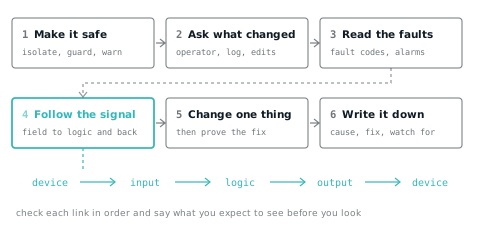
Make it safe and find out what changed before touching the program. Then read what the system already knows: controller faults, HMI alarms, module status. Then follow the signal for the thing that is not happening, from the field device through the input, the logic and the output to the actuator, saying what you expect at each point before you look. Change one thing, prove it, and write down the cause.
Loses marks: going online and editing logic first. The drawing at the top of this page is the order; a troubleshooting method goes further.
19. Should the emergency stop go through the PLC?
Not through a standard PLC. The stop has to work when the PLC has failed, so it is hardwired through a safety relay or handled by a safety-rated controller, and the standard PLC reads its status to stop the sequence and report. Which stop category applies comes from the risk assessment. See emergency stop categories.
20. How do you make a change on a running machine?
Back up the program, agree the change and how it will be tested with the people who run the machine, make the smallest edit, test it with the machine in a safe state, and record what changed and why. Anything that touches an interlock is tested as if it were new. Version control for PLCs covers the record-keeping.
21. A photo-eye count is a few parts out each shift. How do you find it?
Trend the input against the count. A pulse shorter than one scan can be missed, and a bouncing sensor can count twice. Fix the cause first, whether alignment, mounting or the input filter time, and only then consider a debounce timer in software.
22. What happens when the controller powers up or goes from program to run?
On Logix, a prescan runs when the controller powers up in run or moves from program to run, and each instruction has a defined prescan action: an OTE is cleared, a TON is reset, a CTU's count-up bit is set so a held input does not count, and an ONS storage bit is set so it does not fire. OTL bits and retentive data keep their values, so anything latched can come back on. On an S7-1200, startup clears the input image, initialises the outputs and runs the startup blocks once. See the first scan bit.
23. How would you structure a large program?
By machine function, not by instruction type: one routine or block per unit, a state machine for each sequence, user-defined types for repeated equipment, reusable blocks for devices that appear many times, one place where each output is written, and a naming standard someone else can read on a night shift.
24. How do you test logic before it reaches site?
Against written test cases: every sequence step, interlock and fault triggered on purpose in a simulator or on the panel, with the expected result written down before the test and the actual result after it. A factory acceptance test is that, witnessed. See the commissioning checklist.
Behavioural questions
25. Tell me about a fault you found.
Pick one where you had to reason: what you saw, what you suspected, how you proved it, and what you changed so it would not happen again. Interviewers listen for method, and for honesty about what you got wrong on the way.
How to prepare
Write the rungs; do not just read them. Every whiteboard task here runs in the free ladder simulator, and the practice problems add the wrong answers you are likely to be shown. For a recognised credential, ISA's Certified Control Systems Technician programme has three levels. For the route into the job and how to show what you can do, read the PLC career path.
Sources and further reading
- IEC 61131-3:2025 Programmable controllers, Part 3: Programming languages (IEC webstore)webstore.iec.ch
- ISA Certified Control Systems Technician (CCST)isa.org
- Rockwell Logix 5000 Controllers General Instructions reference (1756-RM018)literature.rockwellautomation.com
- Rockwell Logix 5000 Controllers Add-On Instructions programming manual (1756-PM010)literature.rockwellautomation.com
- Siemens S7-1200 Programmable Controller system manualcache.industry.siemens.com
Common questions
- Which PLC brand should I learn before an interview?
- Learn the one in the job advert if it names one, and check which controllers the plants in your area use. The concepts transfer: a candidate who understands the scan, edges, timers and fault finding on one platform can map them to another in days, and interviewers know that. Say which you know and how you would learn the other.
- Is there a certification for PLC technicians?
- ISA runs the Certified Control Systems Technician (CCST) programme, with three levels covering calibration, maintenance, troubleshooting, commissioning and documentation. Level 1 carries a five-year minimum education and experience requirement. Vendors also run their own training courses. Neither replaces being able to write and debug a rung in front of the interviewer.
- Will I have to write code in a PLC interview?
- Often, yes. Many interviews include a whiteboard rung or a short task on a laptop: a start/stop circuit, a toggle, a timed sequence or a counter. Practise writing them from a blank page and explaining each rung aloud, because the explanation is marked as much as the rung. A free browser simulator is enough to practise on.
- What if I do not know the answer to a PLC interview question?
- Say so, then reason out loud from what you do know: how the scan works, what the instruction must do, how you would find out on site. Interviewers hiring for maintenance and commissioning are looking for exactly that habit. A confident wrong answer about a safety function is worse than an honest gap.
- How should I prepare for a senior controls engineer interview?
- Prepare stories as much as answers: a fault you found, a change you made safely, a program you restructured, a commissioning that went wrong and what you changed afterwards. Senior interviews test judgement on safety, change control and structure, and they expect you to explain trade-offs, not recite definitions.
Keep reading
- Languages
Ladder logic to Structured Text: converters, rules and pitfalls
How a rung becomes Structured Text, the rules a converter must follow for timers, edges and latches, and the rungs that convert wrongly unless you test them.
- Practice
PLC ladder logic practice problems with solutions you can run
Nine graded ladder logic exercises, each with a spec, a worked solution, a scan-by-scan explanation and the wrong answer most people write first.
- Fundamentals
What actually happens in one PLC scan
Read inputs, solve logic, write outputs, repeat. Plus the three details in that sentence that cause most of the bugs beginners write.